 ultimate-guide
Choosing Your First Home Defense Handgun: 2026 Guide
Table of Contents
- Start With Purpose: What a Home Defense Handgun Must Do
- Handgun Caliber for Home Defense: What Actually Matters
- Revolver or Semi-Auto: Picking the Action Type
- Fit and Grip: How to Choose a Handgun That Points Naturally
- Home Defense Firearm Laws You Must Check Before Buying
- Handgun Safe Storage: Quick Access Without Compromise
- First-Time Gun Owner Training: The Skills to Build First
- Step-by-Step: Your First Home Defense Handgun Purchase
- Frequently Asked Questions
Last Updated: October 19, 2026
Start With Purpose: What a Home Defense Handgun Must Do
A home defense handgun is a firearm kept specifically to protect your household, and choosing your first one starts with understanding what that job actually demands. The role is narrow: stop a threat at close range, in low light, under stress, often within seconds of waking up. That rules out a lot of what makes a gun fun at the range. A home defense handgun needs to be reliable above all else, simple to operate when your hands are shaking, and secure enough that no unauthorized person can reach it. A defensive gun is a tool with one job, and every choice you make should serve that job. The single biggest mistake we see is buying for looks, capacity, or someone else's opinion instead of for the specific conditions inside your own home.
Handgun Caliber for Home Defense: What Actually Matters
Caliber matters less than most buyers think, and shot placement and control matter far more. Any common defensive caliber will stop a threat if you can put rounds on target repeatedly; a larger round you can't control is worse than a smaller one you can. The real considerations are recoil you can manage, ammunition availability, and how the round behaves indoors.
9mm vs. .38 Special vs. .45 ACP at Indoor Distances
At the distances inside a home, typically a few meters, all three calibers are effective. 9mm offers the mildest recoil among common semi-auto defensive rounds, wide ammunition availability, and higher capacity. .38 Special in a revolver delivers soft, simple recoil with no slide to rack. .45 ACP hits hard but recoils more, which slows follow-up shots for new shooters. For a first home defense handgun, 9mm in a full-size or compact pistol, or .38 Special if you choose a revolver, are common recommendations. The best caliber is the one you can shoot accurately and afford to practice with.
Revolver or Semi-Auto: Picking the Action Type
Revolvers and semi-automatics each have a clear place, and the right pick depends on how much you'll train. A double-action revolver is the simplest defensive platform: load it, close it, pull the trigger. There's no safety to forget, no slide to rack, and it tolerates being left loaded for long periods. The trade-offs are lower capacity and a heavier trigger pull. A semi-auto pistol offers more rounds, faster reloads, and easier recoil management, but it demands more from you: you must rack the slide, understand the safety or decocker, and clear malfunctions. For a first-time owner who will train regularly, a striker-fired 9mm is a strong choice. For someone who won't practice often, a revolver's simplicity wins. Be honest with yourself about which person you are.
Fit and Grip: How to Choose a Handgun That Points Naturally
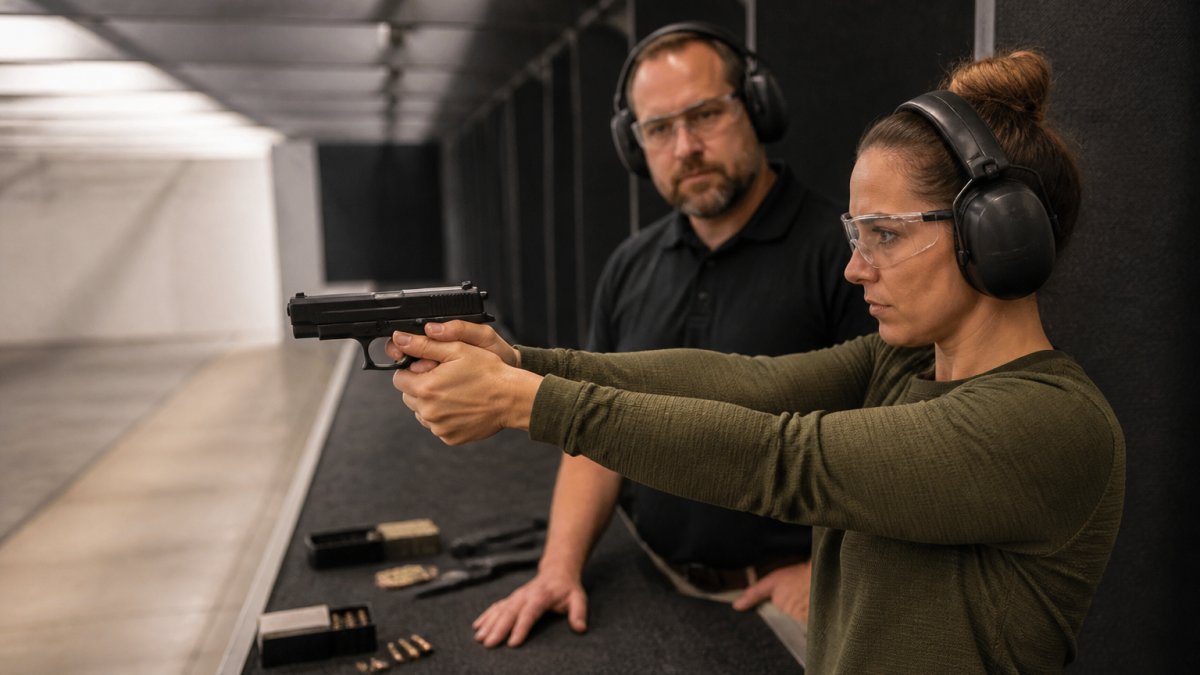
Fit is the most overlooked factor in choosing your first home defense handgun, and it can't be settled online. A gun that points naturally for you lets you bring it up and find the sights aligned without hunting for them. Grip circumference, trigger reach, and the angle of the grip all affect this, and they vary by hand size and shape. Handle several models at a dealer before you commit. What most guides miss is that a compact pistol with a short grip can be harder for large hands to control, while a full-size gun may be too much reach for smaller hands. The right fit feels obvious the moment you hold it. If you can, dry-fire a few options to feel the trigger.
Home Defense Firearm Laws You Must Check Before Buying
Home defense firearm laws vary significantly by state and sometimes by city, so verify your local rules before you buy. The ATF guide to federal firearms regulations covers federal requirements, but state law adds storage mandates, waiting periods, permit rules, and restrictions on magazine capacity. Some jurisdictions require a permit to purchase or a safety course; others impose safe-storage requirements that affect how you keep the gun at home. The National Shooting Sports Foundation's state law resources can point you toward your state's specifics. Do not rely on a friend's advice or a forum post. Confirm the rules that apply to your address directly with your state's official resources, and check whether your purchase must go through a licensed dealer.
Handgun Safe Storage: Quick Access Without Compromise
Handgun safe storage is a balance between keeping the gun away from unauthorized hands and being able to reach it fast when you need it. For a home defense gun, that means a quick-access safe, not a locked cabinet in the basement. Look for a biometric or push-button handgun safe that opens in seconds and mounts securely. The Consumer Product Safety Commission has published guidance on secure firearm storage as a safety measure, and it's worth reading. A good rule of thumb is that if you can't access the gun in a few seconds, it isn't serving its defensive purpose, and if anyone else in the home can access it, it's a liability. A quick-access safe resolves both problems.
First-Time Gun Owner Training: The Skills to Build First
First-time gun owner training is not optional for anyone keeping a gun for defense; it's the foundation everything else rests on. Start with a basic handgun safety and marksmanship course, ideally one that covers defensive use. The skills to build first, in order: safe handling and the four rules of firearm safety, drawing from your storage setup, accurate shooting at close range, and clearing the most common malfunctions. Then practice regularly, even if it's dry-fire at home with a verified empty gun. What most guides miss is that the storage-to-hand transition is a skill in itself; practice opening your safe and getting the gun into a firing grip under mild time pressure. Confidence comes from repetition, not from owning the right gun.
Step-by-Step: Your First Home Defense Handgun Purchase
Buying your first home defense handgun follows a clear sequence. Here's a common sequence:
- Define your defensive scenario. Where in your home would you need the gun, and at what distance? This sets your size and capacity needs.
- Check your state and local laws. Confirm permit, storage, and purchase requirements before anything else.
- Choose a caliber you can control. For most first-timers, that's 9mm or .38 Special.
- Handle several models in person. Verify fit and natural point of aim before deciding.
- Decide revolver vs. semi-auto based on how often you'll train.
- Budget for a quick-access safe and training alongside the gun itself.
- Complete a safety course and practice the storage-to-hand transition.
- Buy from a reputable licensed dealer and keep your paperwork organized.
The steps matter in order because each one narrows the next. Skipping the law check or the fit check is where first purchases go wrong.
| Step | What You Decide | Why It Comes Here |
|---|---|---|
| 1. Define scenario | Size and capacity needs | Sets every later requirement |
| 2. Check laws | Permit and storage rules | Rules out non-compliant options |
| 3. Pick caliber | 9mm or .38 Special for most | Determines recoil and cost |
| 4. Handle models | Fit and natural point of aim | Can't be judged online |
| 5. Choose action | Revolver vs. semi-auto | Matches your training habits |
| 6. Budget safe + training | Storage and skills | Part of the real cost |
Frequently Asked Questions
What should a first-time handgun owner consider for home defense?
Start with three things: how the gun fits your hand, how you will store it so it is accessible but secure, and what training you will commit to. A home defense handgun you cannot grip firmly or operate under stress is the wrong choice, no matter its reputation. Budget for a lockbox or quick-access safe and at least one formal class alongside the firearm itself. Many first-time buyers also rent several models at a range before purchasing.
What caliber is appropriate for a first home defense handgun?
For most first-time buyers, 9mm in a semi-auto or .38 Special in a revolver offers the best balance of manageable recoil, ammunition availability, and effectiveness at indoor distances. Larger calibers like .45 ACP can work but usually mean more recoil and slower follow-up shots for new shooters. The handgun caliber for home defense matters less than your ability to place accurate shots and control the firearm. Try several calibers at a rental range before deciding.
How should I safely store a handgun at home?
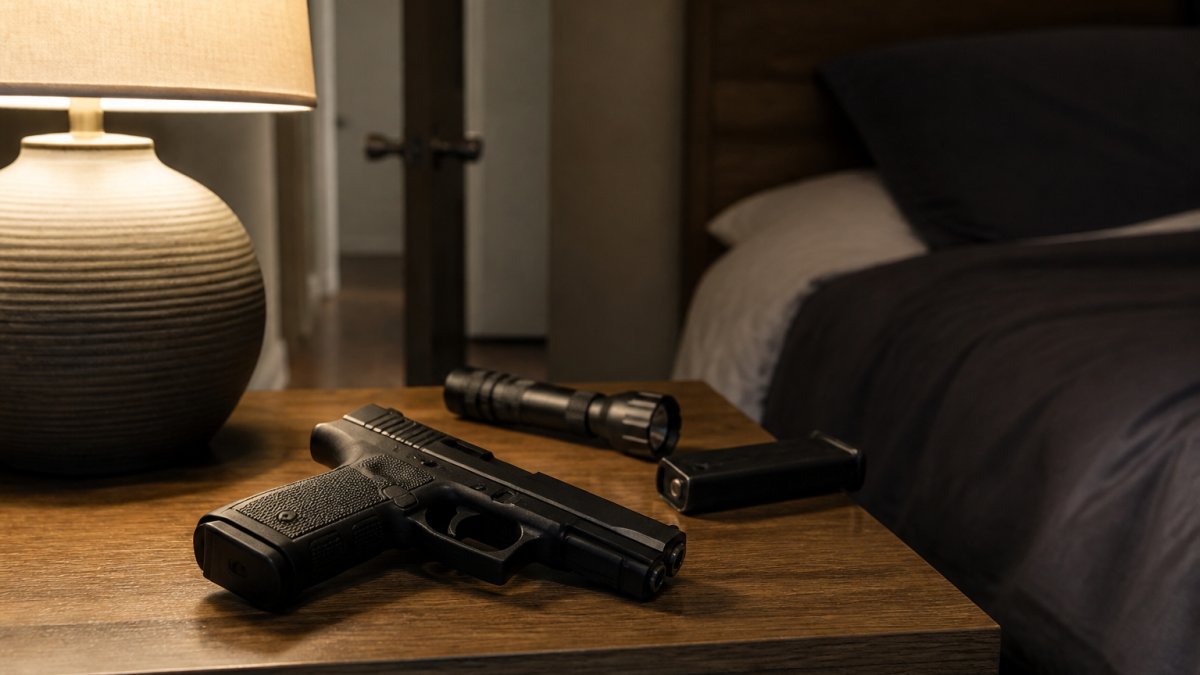
Use a quick-access safe or lockbox bolted down in your bedroom, with the firearm loaded and secured but reachable in seconds. Handgun safe storage should keep the gun out of unauthorized hands while still allowing fast access when needed. Avoid leaving a firearm in a nightstand drawer unlocked, especially in homes with children or visitors. Biometric and keypad safes both work; practice opening yours under time pressure until it is automatic.
What training should I get before owning a handgun for home defense?
Take a basic handgun safety course first, ideally one that covers live fire. Then add a home defense focused class covering low-light shooting, safe room tactics, and decision-making under stress. First-time gun owner training should include regular dry-fire practice at home and live practice at a range at least monthly. Many ranges offer introductory packages that include rental guns, ammunition, and instruction, which is a low-cost way to build fundamentals.
What should I know about local firearm laws before buying a handgun?
Home defense firearm laws vary widely by state and city. Check requirements for purchase permits, waiting periods, background checks, magazine capacity limits, and safe storage mandates where you live. Some states require a license to purchase or possess a handgun, and storage rules can create liability if a child accesses your firearm. Confirm current rules with your state's official resources or a local firearms attorney before you buy, since regulations change.
Is a handgun or a shotgun better for home defense?
A handgun is easier to store securely, maneuver in tight hallways, and operate one-handed, which is why many people choose one for home defense. A shotgun delivers more terminal effect per shot but is longer, heavier, and harder to secure in a quick-access safe. For a first-time buyer focused on storage and training simplicity, a handgun is usually the more practical starting point. Try both at a range before deciding.
Choosing your first home defense handgun is a decision about reliability, fit, and responsibility, not about chasing the biggest caliber or the longest feature list. If you want a straightforward place to start, 2AG Outdoors carries handguns, ammunition, magazines, and quick-access accessories, and our team can help you compare options that fit your hands and your home. Get started with 2AG Outdoors and build a defensive setup you can actually train with and trust.